A May postcard.

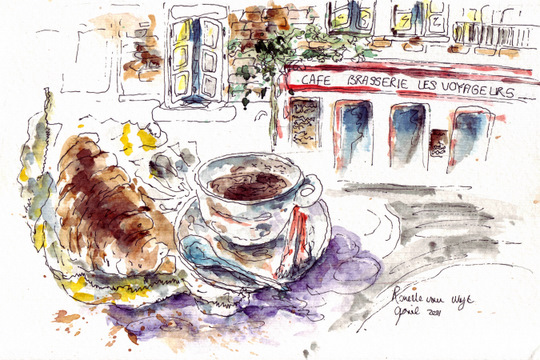
My postcard to Liz in Australia was a challenge and one I really enjoyed. Liz is an avid tea drinker and she is on a quest to try out all the different flavors on the market. I’m not a tea drinker, but I can handle my coffee quite well. So the logical choice for a post card to Liz was of course…an early morning french coffee and a croissant!

…a French coffee and croissant…

Pen and watercolor on watercolor paper.

…and a hint on the envelope…

Pen and gouache on brown envelope

Sketchercise walks 27 and 30 March.

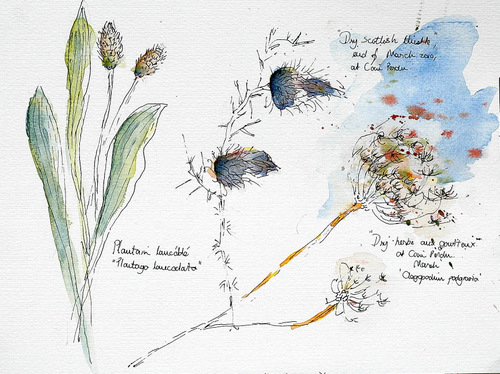
We were for a quick weekend at Coin Perdu, starting some work again. but it was raining and we didn’t get alot done. Went for some nice walks though. On my sketchercise walk I took my pen and sketchbook and roughly sketched some dry weeds from last season. The fileds are covered in flowers, especially the bright yellow marigolds, but since it was overcast, they were all closed.

Here are dry Scottish thistlel, some goutweed and young Plantain.

All sketches in pen/pencil and watercolor wash in Sketchercise book, 18x25cm.

This morning on my walk here in Montlouis, the weather was as bad,  if not worse. It is alwasy a few degrees warmer in Correze than it is here. I went for my walk, having a hanglip becasue of the weather. My bones are asking for good spring and summer weather now! I need to be outside now, in nature and in the sun and by the river and bare arms and walking barefoot!

So here are some frustrated sketches from this morning’s walk in un temps de chien(awful , dog weather)!

A daffodil and hyacinth and tulip encountered on my walk, as also an underground water pipe.

A sunny Forsythia in bloom, and a curb and flowerbed near my home.

Food sketches and a book on dining and painting

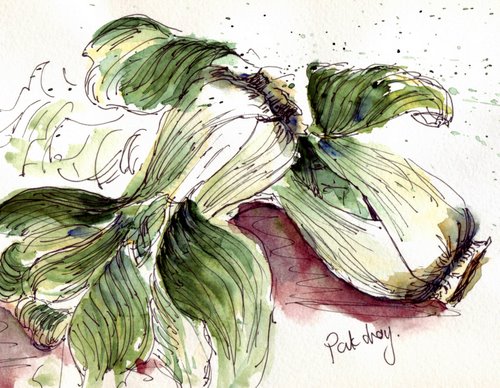
I’ve said this before…if all else fails, paint food. It really works. Whether it is the sensuality of food, or the colours or the health aspect or hunger or satisfaction or all of it together…painting food is a delight. It has been so for ages as you will see further down below. I had some poivrons cornes de boeuf and some pak choy. Both greens which is good practice in the greens once again.

…green peppers…
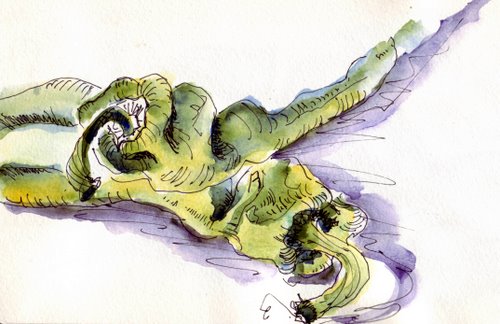
green peppers

…pak choy…

Pak shoy

…Sketches done in moleskine with rotring pen and watercolour….

When Katherine visited in October, she and her sister and niece came over for dinner on their last night in France. (See both her sites at Travels with a sketchbook and Making a mark – where she has some interesting facts in her latest post on Technorati.)

Apart from the bottle of champagne they brought which we décapitée (beheaded) Napolean style, they brought me this beautiful book too  – Boire et Manger, which they bought at Chateau Chenonceau. I have read it from front to back and back to front again. I love symbols and mythology and traditions and of course everything that has to do with food and art and this little book has it all.

It is all about the traditions and symbols showing up in old works of art, throughout the ages; how artists chose to paint certain food and scenes, involving food  for their symbolism, to depict the traditions and cultures and habits – in short, life during their time.

I want to share some of it with you. Different examples can be seen at Myfrenchkitchen.

…BOIRE ET MANGER…

.. bacchus adolescente:Le caravage(1596-1597)…

boire et manger

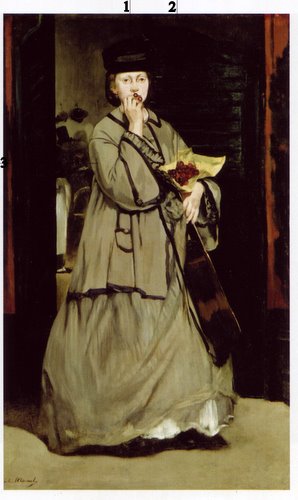
…la chanteuse des rues; édouard manet (1862)…

la chanteuseCherries – meaning: Passion of Christ, fruit of paradise

  1. One of the first portraits of Victorine Meurent, who was one of Manet’s favourite models until 1875.
  2. The cherry was a symbol of love, becasue of its deep red colour and round voluptiousness that reminded of the curves of the feminine body.
  3. All the sensuality in this scenes evolves around the woman bringing the sweet cherries to her mouth.

…la céne: Jacopo Bassano ( 1546-1548)…

la céne

Lamb – meaning: sacrificial victim.

  1. The lamb signifies the sacrifice of Christ.
  2. A fruit, resembling the apple, signifies the original sin.
  3. Next to Judas lies the knife, symbol of the treason which would follow.
  4. With his left hand, Jesus Christ himself points to the lamb which is a symbol of his own sacrifice.

…le jambon: édouard manet  (1875-1878)…

le jambon - eduard manet

Meat ; conserved/dried: ham taken from the porc, signifies gluttony sin.

  1. French dried ham had a strong international culinary meaning for Manet, because of its ancient gallic imports and long French tradions.
  2. In the 19th century the ham became a commercial product and thus also made its appearance in the city bourgeoise home after being traditionally country fare.
  3. In the rich Parisien home the ham would be served on nothing less than silver plattters, giving the ham a “worthiness”.

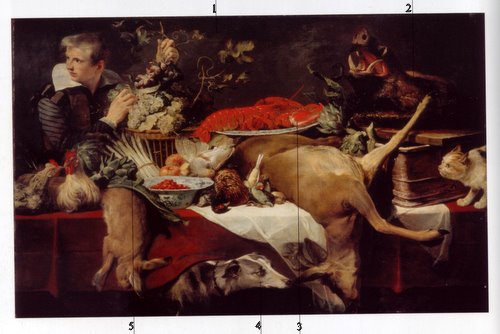
…scéne de cuisine: Frans Snyders (1630-1640)…

scene de cuisine

Porc and wild boar: sin of the flesh.

  1. Frans Snyders was a student of Rubens and specialized in refined commissios, usually overladen scenes of buffet tables with exquisite  food.
  2. The head of the boar was very sought after and seen in this “hunting” painting could be evidence of a commission by  some articrat.
  3. The lobster was already at that stage seen as one for the more rare sea foods, giving it an importance on the refined table.
  4. The little detail of the dog only sniffing the game, hints on aspects of respect.
  5. The presence of the artichokes is an indication of the choice of the painter to include only exquisite foods.
Just some sketches….and a vendange in Vouvray.

Every year I paint these clementines from la Corse. See last year’s sketches at CLementines.

…clementines from Corsica…

clementines in watercolourSketch done in moleskine with pen and watercolour

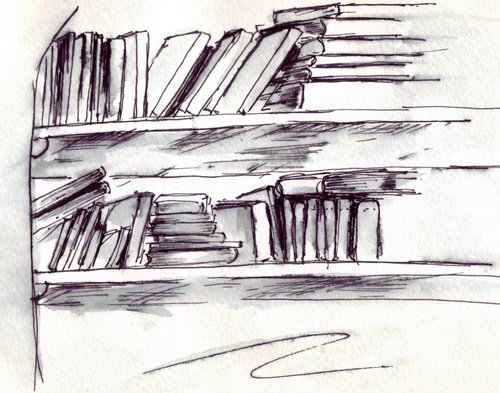
The next two sketches were done a while ago. I just sketched some things around me – a container in the living room with brushes and pens and stuff and part of a bookshelf. I try very hard to keep the bookshelf, neat, but I am starting to think we will never have neat bookshelves.

..brushes and pens…

brush holder

…disorder…

books on the bookshelf

Sketches done in Moleskine with rotring artist pen and water wash.

On Myfrenckitchen, I have posted some photo’s of a vendange in Vouvray that we did in Octobre. Good freinds have a bio vineyard where the harvesting is still done by hand. On one Saturday during the harvest period in October, all their family and friends get together for a day of grape harvesting. It was hard work, but a fun day, with a delicious lunch,  many laughs and jokes and a messy grape fight towards the end of the day. I only took photos, because I didn’t want to hide from the work behind my sketchbook! you can see some photo’s here at Pears in red wine and a wine harvest.

vendange-grapes

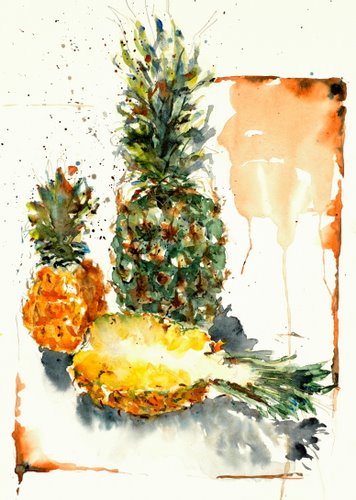
Splashy pineapples

Yesterday I had a crazy craving for pineapple. I bought whichever ones I could find…the sweet small Victoria pineapple from South Africa, the big fat watery one, produced in Costa Rica, coming from Miami???… and lastly the heavy, juicy one from the Ivory coast. Of course I had to paint them. My light pencil drawing was fine and I started putting in washes. Arriving at the spiky leaves, all went horribly wrong. And from there it on it was downhill all the way. Finally I threw the paintbrush out the door, flew out of my atelier, jammed a cup of coffee together, grabbed a canvas and plastered it with modeling paste and a painting knife. Halfway through the oil painting, and eventually simmered down, I turned to my watercolour and thought I might as well finish it by simply pulling out all the stops, I have nothing to lose. So here is the final messy watercolour….. the oil painting is still drying.

Watercolour on Fabriano artistico HP extra white block, 30,5×45,5cm (12″x18″)

Afterwards I even had some time to put a recipe together…and  eat it all. Interested in Pineapple carpaccio with saffron syrup and roasted pinenuts?

Foire aux vins(Wine fair)

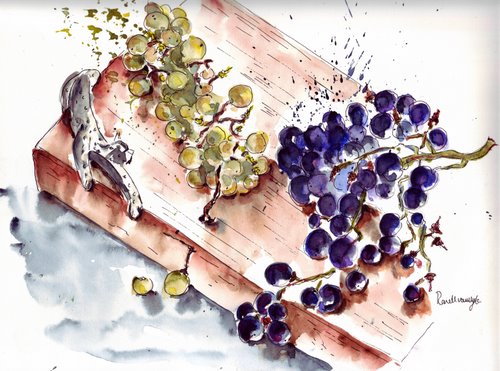
September/October is time for Foire aux vins in France. Time to refill those empty spaces in the wine cellar. Try out new wines, restock on old favourites. I enjoy a good red wine. But most of all, I enjoy the grapes. My favourites being Muscat(dark) and Chasselas(green). So I’ll have the grapes now and save the wine for later.

…let there be wine…

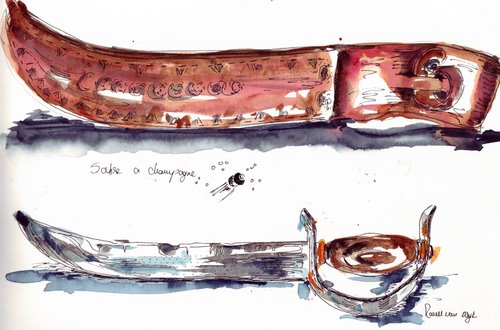
Sabre à champagne – a tradition dating from the Napolean empire. Coming back from a battle, the cavalry would pay tribute to victory, vigour, virility and of course…women, by opening up bottles of champagne with theatrical flaunt and flare. The cold bottle is held at the bottom and with a swift movement of the sable from bottom to the neck, the “cork is popped” right under the rim. A clean chop, leaving no shattered glass.

(Edit: I just realized how crooked this sword looks with the completely “off” shadow under the blade! Yes,  I confess. I held the sword in my hand and thus cheated on “seeing” the shadow on the surface…now that says a lot for competence…and I didn’t have a single sip!)

…”en garde!”..

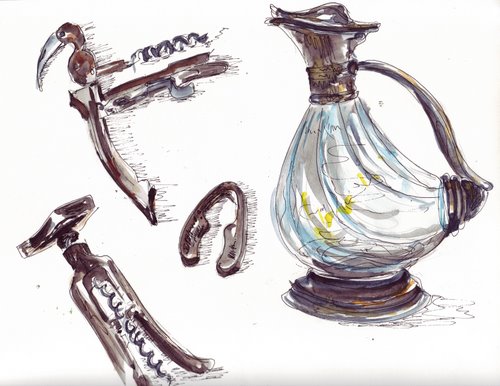
Some fancy bottle openers are available today. The most efficient and quickest still remains the “couteau de sommelier“, which is the all-in-one every “garcon” (waiter) walks around with in his pocket.

And how about a decanter for aged wines to separate from their deposits, or a carafe for a young wine to “breathe”

…”1 2 3 breathe!, 1 2 3 breathe”…

I did intend to do more sketches showing the fun of the Foire aux vins, but laziness got the better of me. I think I’ll just stick to finishing the grapes I’ve sketched and open a Pomerol with dinner tonight.

Sketches done in pen and watercolour on Fabriano artistico block, 22×29, 5cm.